
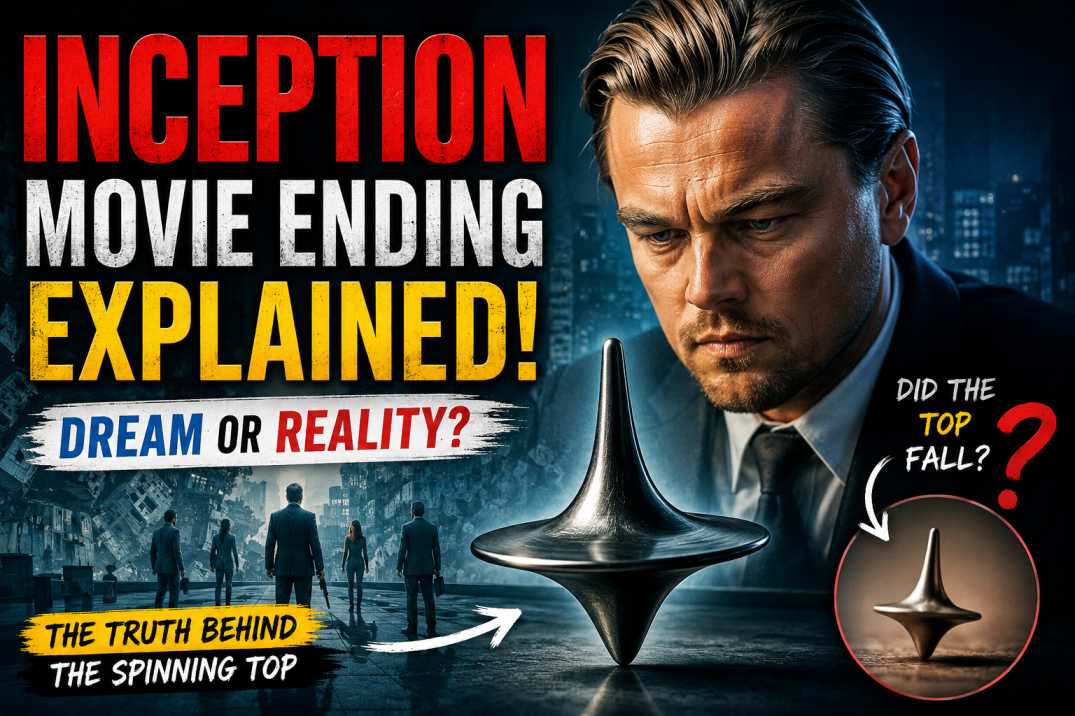
If you’ve been searching for an Inception movie ending explanation, you’re certainly not alone. Ever since Christopher Nolan’s Inception was released in 2010, its ending has remained one of the most discussed and debated conclusions in film history. Millions of viewers have watched the movie multiple times, trying to determine whether Dom Cobb finally returned to reality or remained trapped inside a dream.
The famous spinning top in the final scene has inspired countless theories, YouTube videos, and online discussions. But what does the ending really mean? In this Inception movie ending explanation, we’ll analyze the final scene, examine the hidden clues throughout the film, discuss Christopher Nolan’s own comments, and determine the most convincing interpretation.
Table of Inception movie ending explanation
A Brief Overview of Inception
Directed by Christopher Nolan, Inception is a science-fiction thriller that explores the idea of entering and manipulating dreams. Dom Cobb (Leonardo DiCaprio) is an expert “extractor” who steals secrets from people’s subconscious minds while they sleep.
Instead of stealing an idea, Cobb is given an impossible mission—to plant one inside Robert Fischer’s mind, a process known as inception. If he succeeds, his criminal record will be cleared, allowing him to return home to his children after years of exile.
However, Cobb is haunted by memories of his late wife, Mal, whose appearance inside his dreams constantly threatens the mission.
Inception Movie Ending Explanation: A Quick Recap
After successfully completing the inception mission, Cobb wakes up on the airplane alongside his team. Everything appears normal.
He passes through airport security without any issues, meets his father-in-law Miles, and finally arrives home. His children are playing in the garden exactly as he remembered them.
Before embracing them, Cobb places his spinning top—his supposed reality-checking totem—on the table.
The top spins.
The camera focuses on it.
It begins to wobble…
Then the screen cuts to black.
That single cut has created years of debate.
Top 7 Best Horror Movies You Must Watch: The Ultimate List for Horror Fans
Understanding the Totem
One of the most important parts of any Inception movie ending explanation is understanding the purpose of the totem.
A totem is a personal object used to determine whether someone is inside a dream or in reality.
Cobb uses a spinning top.
- In a dream, the top spins forever.
- In reality, it eventually loses momentum and falls.
However, there’s one detail many viewers overlook.
The spinning top originally belonged to Mal—not Cobb.
Earlier in the film, Arthur explains that a totem only works because its owner knows its exact weight, balance, and feel. Since the top belonged to Mal, some fans argue it isn’t actually Cobb’s true totem.
This means the audience may be focusing on the wrong object entirely.
The Biggest Clues That Cobb Is in Reality
Most evidence throughout the film supports the idea that Cobb finally returns to the real world.
1. Cobb Isn’t Wearing His Wedding Ring
Perhaps the strongest clue in this Inception movie ending explanation is Cobb’s wedding ring.
Observant viewers noticed that:
- During dream sequences, Cobb wears his wedding ring.
- During scenes set in reality, he does not.
In the movie’s final scene, Cobb is not wearing the ring.
Many fans believe this visual clue is Christopher Nolan’s quiet confirmation that Cobb has finally awakened.
2. The Top Starts to Wobble
Just before the screen cuts to black, the spinning top slightly wobbles.
Throughout the movie, dream totems spin with unnatural perfection.
A wobble suggests gravity is taking effect.
Although Nolan never shows the top falling, it appears ready to do so only moments later.
3. Cobb Stops Looking
Another fascinating detail is Cobb’s behavior.
Earlier in the film, he desperately checks whether he’s dreaming.
In the final scene, he spins the top—but never waits for the answer.
Instead, he walks away to hug his children.
This emotional decision is arguably more important than whether the top falls.
4. The Mission Is Complete
Every member of Cobb’s team successfully wakes up after the synchronized kick.
Nothing unusual happens afterward.
The airport sequence feels calm, grounded, and realistic compared to the surreal dream worlds shown earlier in the movie.
Why Some People Believe It’s Still a Dream
Despite the evidence, many fans disagree.
A complete Inception movie ending explanation should also consider the opposing arguments.
The Children Look Almost the Same
Cobb’s children appear very similar to how they looked in his memories throughout the film.
Some viewers argue this suggests he never truly escaped his subconscious.
However, a closer look reveals they’re slightly older and wearing different clothes than in previous scenes.
Everything Seems Too Perfect
The mission succeeds.
His legal problems disappear.
He returns home immediately.
His children are waiting.
Some fans believe life simply works out too perfectly to be reality.
But this could also represent the reward for completing an incredibly dangerous mission.
Nolan Never Shows the Top Falling
The biggest argument for the dream theory is obvious.
If Cobb were truly in reality, why cut away?
Christopher Nolan intentionally refuses to give audiences absolute certainty.
What Christopher Nolan Has Said
Christopher Nolan has repeatedly explained that the real meaning of the ending isn’t about the spinning top.
Instead, it’s about Cobb’s emotional journey.
For years he was trapped by guilt over Mal’s death.
By the end of the film, he finally lets go.
Whether he’s dreaming or awake no longer matters to him.
That emotional freedom is the true ending.
Michael Caine’s Revelation
Years after the movie’s release, Michael Caine, who plays Miles, shared an interesting piece of information.
According to Caine, Christopher Nolan told him that every scene featuring Miles takes place in reality.
Since Miles appears in the airport sequence near the end, many fans consider this the strongest confirmation that Cobb really made it home.
While Nolan himself has never officially confirmed the ending, this statement strongly supports the reality interpretation.
Why the Ending Still Works
The brilliance of the film lies in its ambiguity.
A great Inception movie ending explanation doesn’t simply answer whether the top falls.
Instead, it highlights the emotional transformation of Dom Cobb.
At the beginning of the movie, he is consumed by guilt, grief, and doubt.
By the end, he chooses his family over certainty.
Whether the audience knows the answer becomes irrelevant because Cobb himself no longer needs it.
That’s what makes the ending unforgettable.
Final Verdict: Dream or Reality?
After examining all the clues, the evidence strongly suggests that Cobb is finally back in reality.
The missing wedding ring, the wobbling top, Michael Caine’s appearance, and Cobb’s emotional growth all point toward a genuine reunion with his children.
Christopher Nolan intentionally leaves a tiny element of uncertainty because the story isn’t about proving reality.
It’s about learning to let go.
That is why Inception remains one of the greatest science-fiction films ever made.
Conclusion
This Inception movie ending explanation shows why Christopher Nolan’s masterpiece continues to fascinate audiences more than a decade after its release. While the spinning top remains one of cinema’s greatest mysteries, the emotional evidence strongly indicates that Dom Cobb finally returns home and chooses to live in the present rather than remain trapped by the past.
If this Inception movie ending explanation taught us anything, it’s that sometimes the most important answers aren’t about what we see—they’re about what the characters choose to believe. Whether you think the ending is reality or another dream, Inception succeeds because it invites every viewer to reach their own conclusion, ensuring that its final scene will continue to be debated for many years to come.